Project 01 · AI
Farm document processing
AI reads the farm's incoming paperwork and turns it into structured records, so a person checks each document once instead of typing it up.
- Category
- AI
- Stage
- In use
- Availability
- Contact us
- Last update
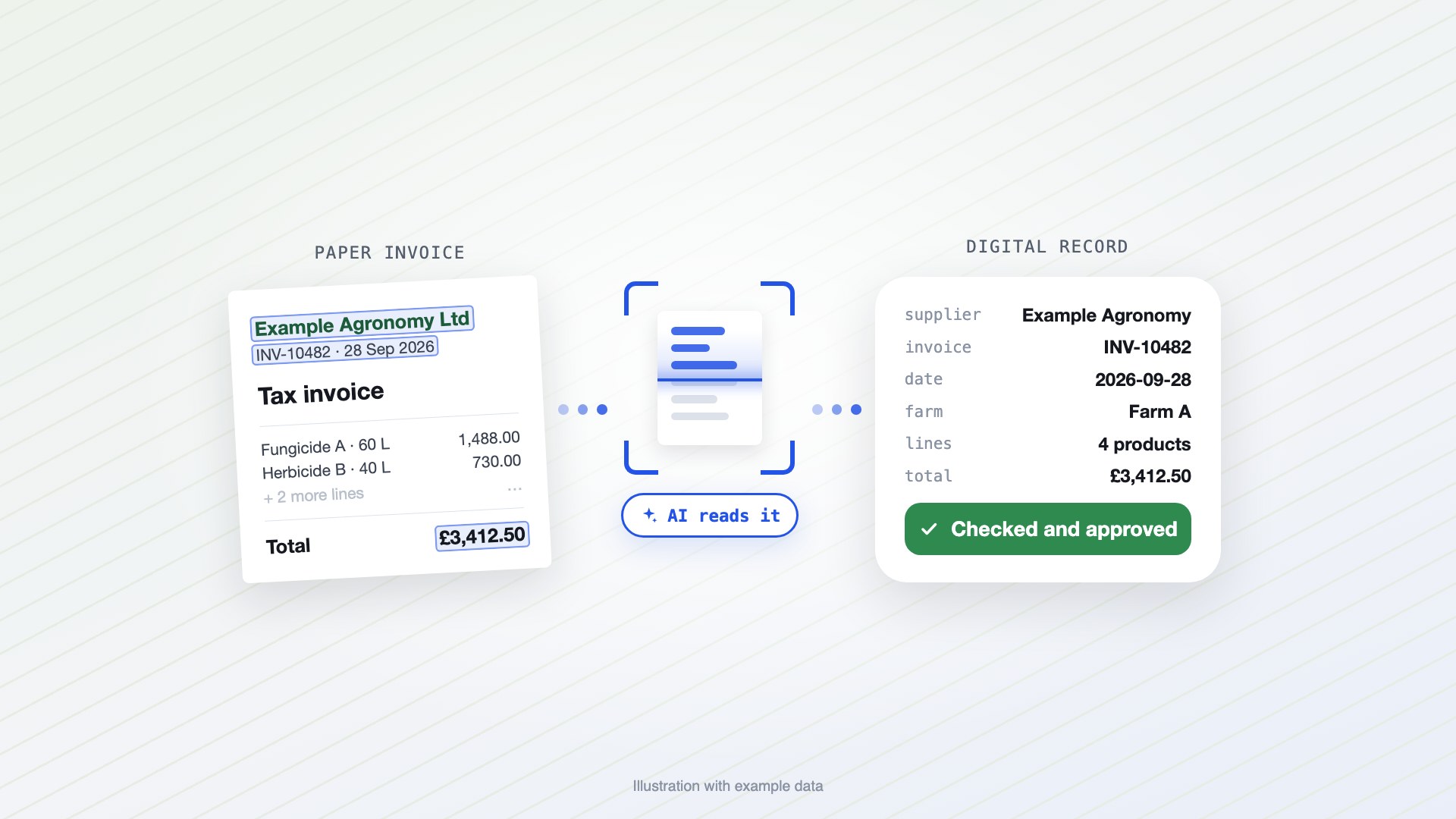
The problem
A farm office runs on paper. Supplier invoices, delivery notes, grain contracts, weighbridge tickets, statements and remittances arrive every day, mostly by email and sometimes on paper. Each one has to be read, coded for the accounts, filed in the right place, typed into the right record, and sometimes sent on to the accountant.
None of it is difficult, but it is slow, easy to get behind on, and easy to get slightly wrong. When it slips, the stock records, the grain position and the accounts all drift out of step with what actually happened.
The idea
Let AI do the reading and the typing, and keep a person in charge of what gets recorded.
Every document goes through the same steps. AI works out what the document is and reads it into a fixed form for that kind of document. A person checks that form against the document and approves it. Ordinary code then does the filing and recording, the same way every time.
The AI never writes to the farm’s records itself. It only proposes. Nothing is recorded until a person has approved it.
AI reads and proposes Person checks and approves Code does the same thing every time
- Arrives CodeAn email to the farm office inbox, pages from the office scanner, or a file uploaded by hand. Each document becomes one task.
- Sort AIWorks out what kind of document it is. A scanned bundle is split into separate documents. Anything it is unsure about goes to a person to sort.
- Read AIFills in a fixed form for that type: who it is from, dates, totals and every line. Checks such as "do the lines add up to the total" run before anyone sees it. If they fail, it tries again, and then hands over to a stronger model.
- Check PersonSomeone looks at the document beside what was read from it, corrects anything wrong and approves. Once.
- File and record CodeStamps the accounting code on the PDF, files it, adds it to the farm database, tags the email, and sends invoices on to the accountant. Every step can be undone.
What it looks like
Everything happens in a custom interface for managing farm documents. Each document sits in a queue that shows where it has got to: waiting to be sorted, waiting for a check, being filed, done.
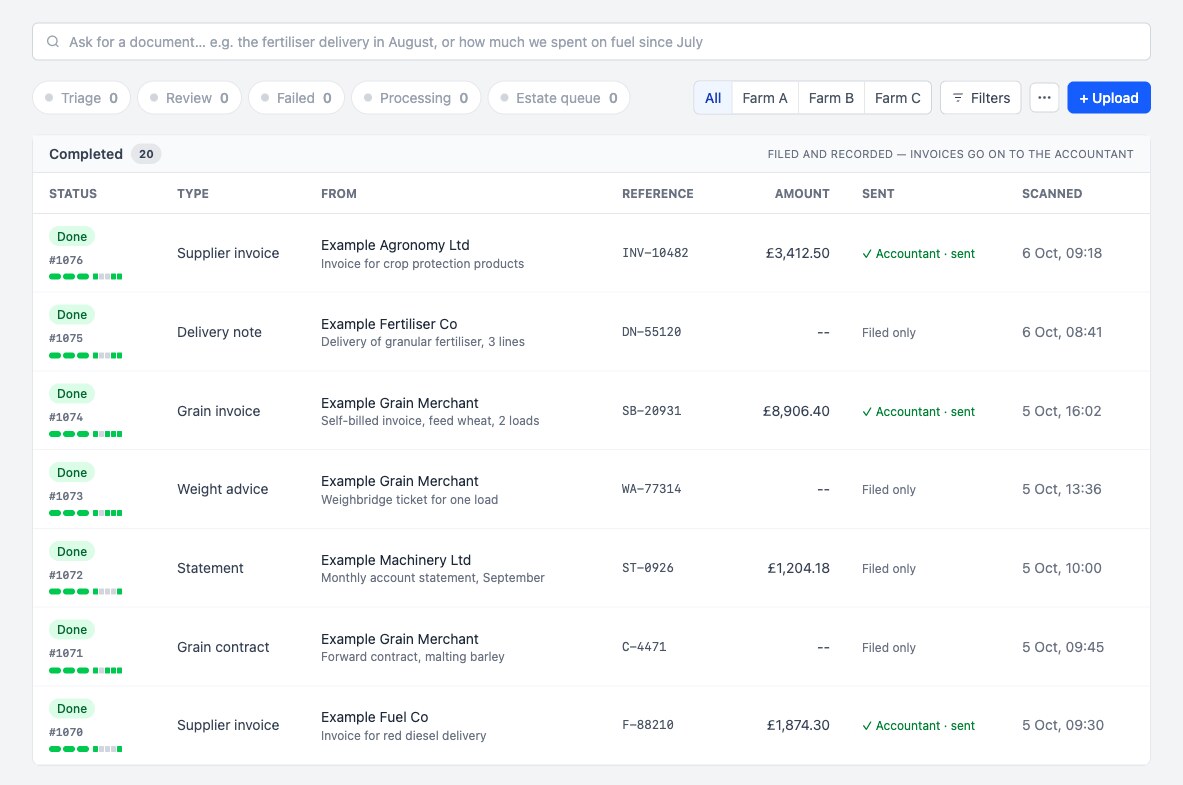
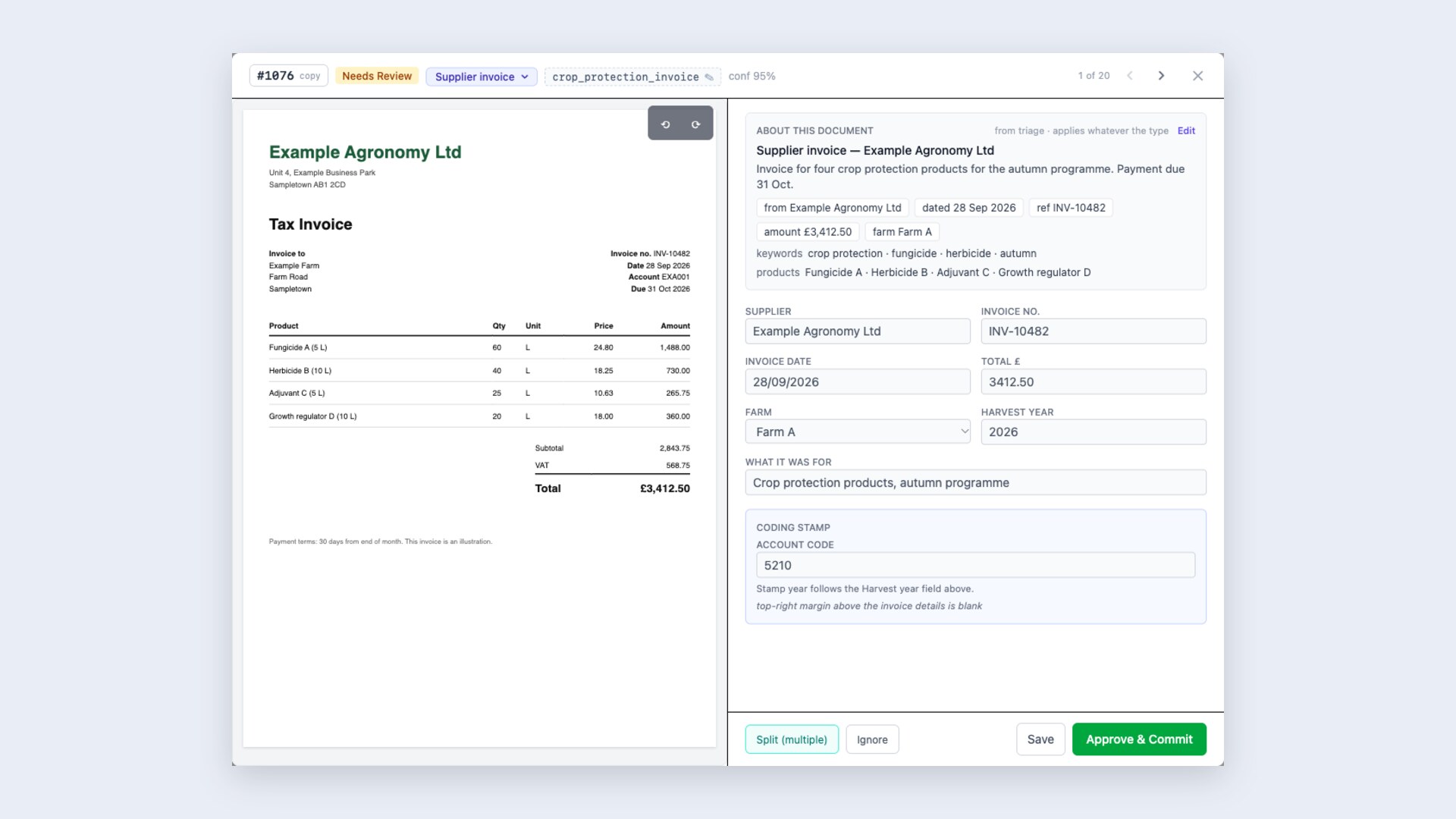
Opening a document shows the page itself on the left and what was read from it on the right. Most checks take a few seconds: glance across, fix anything that is wrong, approve.
The time it saves
- hours of office time saved so far
- ~54
- hours saved a month at the current rate
- ~11
- values read from documents instead of typed
- 9,000+
- documents approved with no corrections
- 6 in 10
Since March 2026 the system has filed and recorded more than 700 documents, and it now handles about 145 a month. Dealing with a document by hand took around five minutes: read it, code it, file it, type it into the records and forward it. Checking what the AI has read takes around thirty seconds. That difference adds up to about 54 hours so far.
These figures are estimates: the document counts come from the system itself, and the minutes per document are our own judgement.
More than time saved
- Find anything in seconds. Every document is filed and described, so a search box can answer plain questions, such as “the fertiliser delivery in August” or “how much have we spent on fuel since July”, in about two seconds. Before, that meant digging through inboxes and folders.
- Done the same way every time. Every document is coded, named and filed consistently, and invoices reach the accountant without anyone remembering to forward them.
Structured data is the stepping stone
Checking documents instead of typing them up saves around 11 hours a month. The bigger saving comes from what happens next.
Once a document becomes a structured record (supplier, products, quantities, prices, dates), the office work that depends on it can be automated too: organising the paperwork for quality assurance audits, reconciling invoices for the accountant, ordering inputs and keeping stock records up to date. Each of these used to mean gathering and cross-checking documents by hand. Automating them can save tens of hours a month, and every new workflow builds on the same data.
28 Sep 2026
Fungicide A · 60 L · 1,488.00
Herbicide B · 40 L · 730.00
+ 2 more lines
Total £3,412.50
- supplier
- Example Agronomy Ltd
- invoice
- INV-10482
- date
- 2026-09-28
- farm
- Farm A
- lines
- 4 products, qty, price
- total
- 3412.50
- code
- 5210
- Quality assurance audits
- Invoice reconciliation for the accountant
- Input ordering
- Stock keeping
- Invoices still to pay
Low cost, and no lock-in
Most documents cost well under a penny of AI processing. The harder ones, which need a stronger model, cost a few pence.
That is possible because the system isn’t tied to one AI company. It connects to models through a service that offers hundreds of them from many providers. We test candidates against our own set of real, hand-checked documents and choose on accuracy, speed and cost. Today, small open models such as Google’s Gemma do most of the work, and Anthropic’s Claude steps in when they can’t produce a valid answer. When a better or cheaper model appears, switching is a settings change and a test run, not a rebuild.
How it is kept reliable
- Fixed forms, not free text. Each document type has its own form with rules, so the AI’s answer is either valid or rejected. It can’t invent a field or quietly skip one.
- Tested every night. The set of real documents is run through the live system each night and scored field by field. Nothing that changes how documents are read goes live without passing it.
- Safe to retry, easy to undo. Each step records exactly what it did, so a document can be undone cleanly, and a crash halfway through never leaves a half-filed document behind. Emails to the accountant are never sent twice.
Where it is now
The system has been in daily use on our farm since March 2026, handling the farm office’s paperwork across the farm’s businesses. It understands 15 types of document, including supplier and grain invoices, delivery notes, statements, grain contracts and bookings, weighbridge tickets, collection notes and remittances.
Next steps:
- Automatic approval. Let routine, low-risk documents skip the check once they have proven, document type by document type, that they are always read correctly.
- Automatic document type generation. When a new kind of paperwork turns up, the system drafts the form and instructions for it, ready for us to review, instead of us writing them by hand.
- More office workflows built on the structured data it already produces.
The tool isn’t generally available, but we are open to projects. If your farm or business has the same paperwork problem, we would like to hear from you. Use the button below.
Links and enquiry
Interested in this project, or something similar for your own farm or business?
Related projects
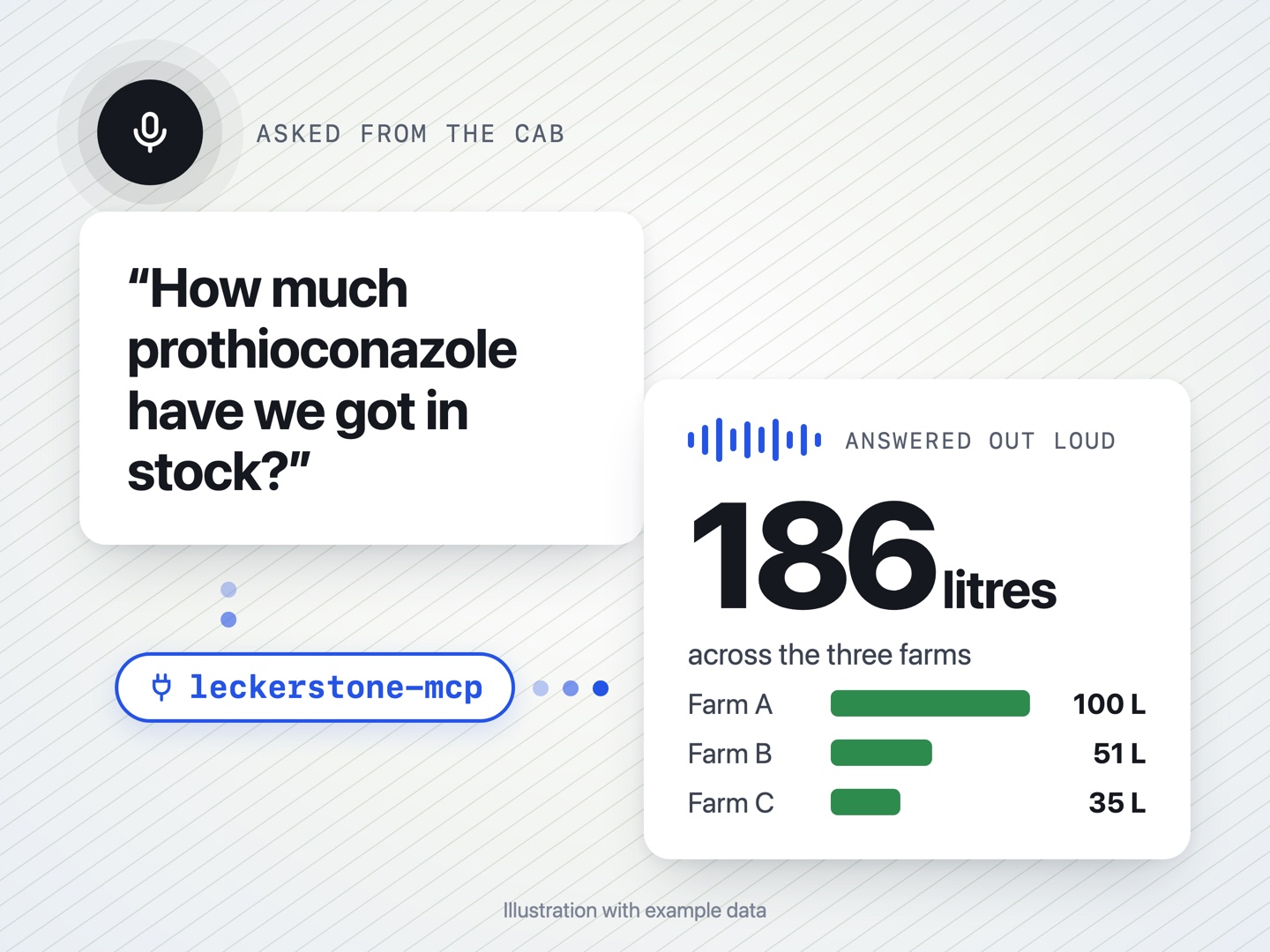
AIIn use
AI connectors
A safe connector between AI agents and the farm's records, so assistants such as ChatGPT, Grok and Claude can answer questions by voice from the tractor seat and take on work in the farm office.